Twine + Cyera: From Detection to Resolution
How the Twine + Cyera Integration Closes the Loop Between Data Risk Discovery and Identity Remediation
Identifying sensitive data exposure is a critical first step in reducing data security risk. Cyera provides data discovery, classification, exposure, and risk context across the enterprise.
Remediation, however, requires additional identity and organizational context. Organizations must determine who is behind the access, whether the access is appropriate, who is accountable and what corrective action should be taken.
Twine complements Cyera by correlating its findings with identity and entitlement data from systems such as SailPoint, Workday and Microsoft Entra ID. This enables Twine to prioritize remediation based on data sensitivity and identity risk, validate ownership, right-size access and execute approved actions with an auditable workflow.
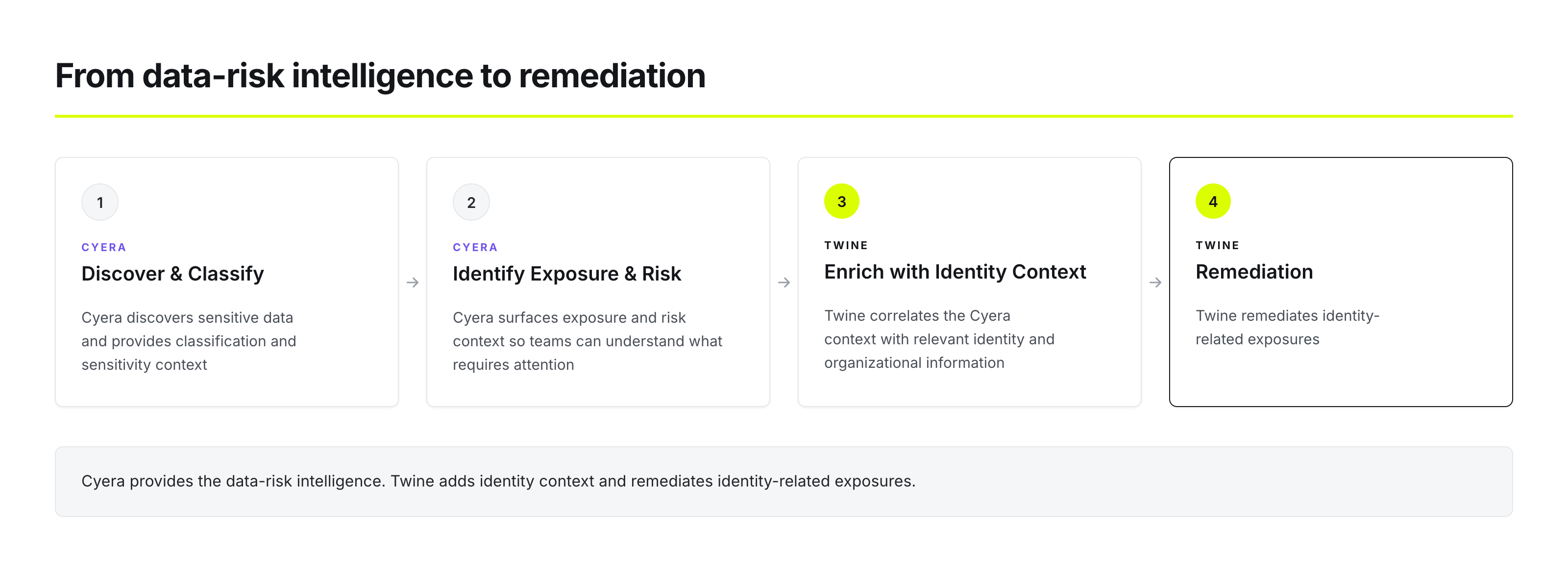
Together, Cyera and Twine enable a closed-loop approach: Cyera provides the discovery, classification, exposure, and risk context, while Twine adds identity and organizational context and remediation capability.
The Customer Challenge
Enterprises run identity governance disconnected from data risk: access reviews, deprovisioning, and entitlement cleanup happen without knowing which accounts actually touch sensitive or exposed data. This leaves a patchwork of manual reviews and spreadsheet-driven audits, so high-risk entitlements go unaddressed while IAM teams spend cycles on low-risk accounts.
Put another way, two teams see two different halves of the same problem:
• Data security teams see exposure, where sensitive data lives and how exposed it is
• IAM teams review access, but in today's modern ecosystem what an account touches is so complex that a person cannot understand the actual risk. Service accounts in particular commonly lack a confirmed human owner, so entitlement cleanup and MFA enforcement stall, and access to sensitive data behind these accounts can go unaddressed for months.
Two Complementary Capabilities, One Integrated Workflow
Identity risk has two halves, and each one is genuinely hard on its own.
Part 1 Finding It
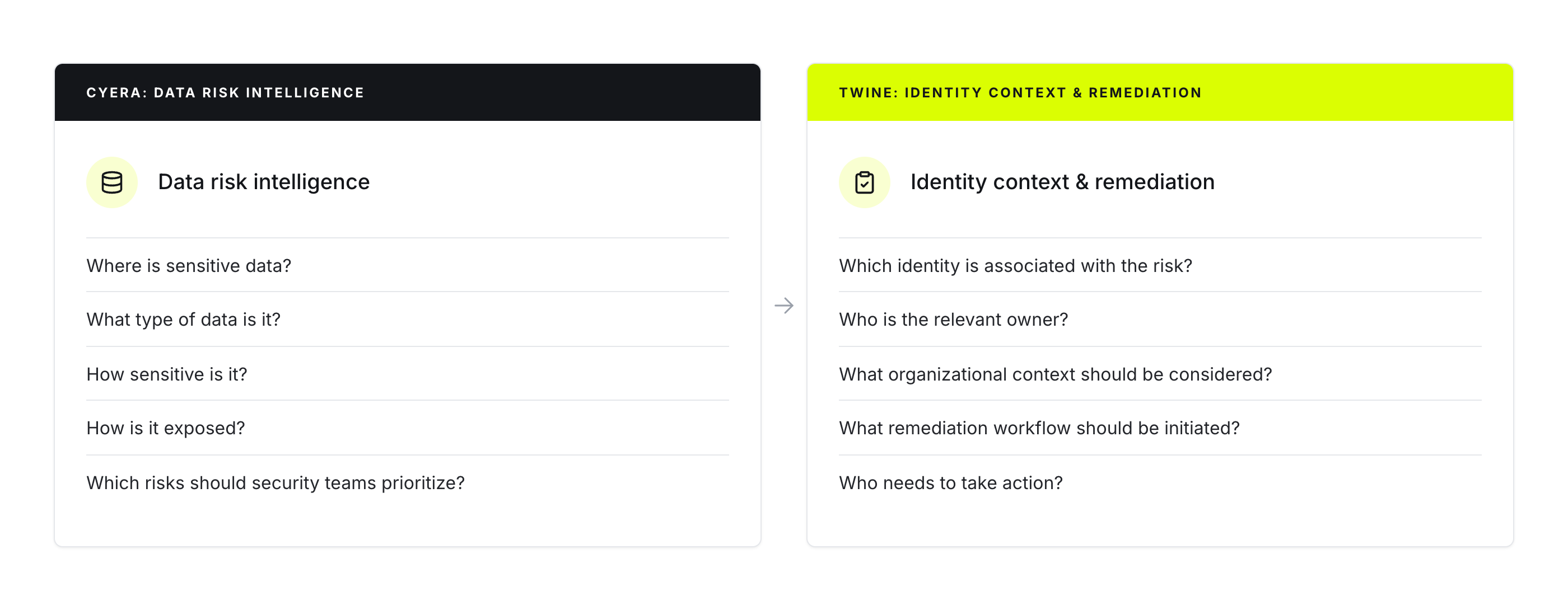
Cyera continuously discovers where sensitive data lives across the enterprise, classifies what type of data it is and how sensitive it is, and surfaces how it's exposed, consolidating accounts, entitlements, and access paths into a unified Access Graph and prioritizing which risks matter most. This data-risk intelligence, covering contexts such as employees, customers, geolocation, and more, is the foundation everything else depends on.
without intelligence, there's nothing to act on.
Part 2: Remediation
Cyera's data-risk intelligence tells security teams what's exposed and how urgent it is. Twine brings the identity and organizational context: which identity is tied to the risk, who the relevant owner is, and what the organization's own policies say should happen next. It feeds those signals into the same Access Graph, mapping an exposed account to a real person and that person's full identity footprint across the organization's identity ecosystem.
In short: Cyera provides the what and the why. Twine provides the action.
How the Integration Works
Twine pulls Cyera's intelligence, along with the full context around each finding, into its knowledge and data fabric, overlaying the organization's behavior, policies, and identity context to build a remediation plan.
Data ingested: Cyera datastores, data-risk issues, the identities Cyera tracks against those datastores, and the issue-to-identity associations between them.
Enrichment: Alex matches Cyera's identities to the identity fabric it has built across Twine's other connected data sources, attaching a per-account sensitive-data-exposure risk attribute to each one.
Automation triggered: using that risk attribute, its knowledge of organizational policy, and its full understanding of the identity fabric, Alex kicks off a remediation workstream that conforms to in-place policies and processes.
Unified Identity & Account Fabric
Every account across connected applications is normalized into a single Accounts view, tagged by source system (e.g., SailPoint, Workday, Microsoft Entra), classification (Primary, Service, Test), geolocation, and status. With Twine's knowledge and behavior fabric, a data-exposure finding is never an orphaned fact: it's automatically attached to a specific person or service identity, complete with department, title, and location, and to that identity's full account graph across every connected system.
From Finding to Assigned, Auditable Task
After providing all this context, the exposure moves from intelligence into Twine's remediation workflow rather than sitting as a chat answer or dashboard entry. The workflow enables remediation tasks, with:
A defined scope (the specific flagged accounts)
Attached reference files (the underlying policy documents)
Suggested step-by-step instructions like:
- Review account details (MFA status, last sign-in, last password change, sensitive-records exposure)
- Check for a designated owner in the identity system, falling back to a named contact if none is found
- Identify the specific remediation actions required (MFA enablement, password rotation, owner assignment)
- Send an email or Teams message to the owner or fallback contact confirming the access is genuinely needed and listing the required actions
- Document everything: issues found, who was contacted, and what was requested
Configurable scheduling (run once now, or repeat on a cadence, e.g. weekly, until resolved) and delivery options (e.g., emailed as a summary)
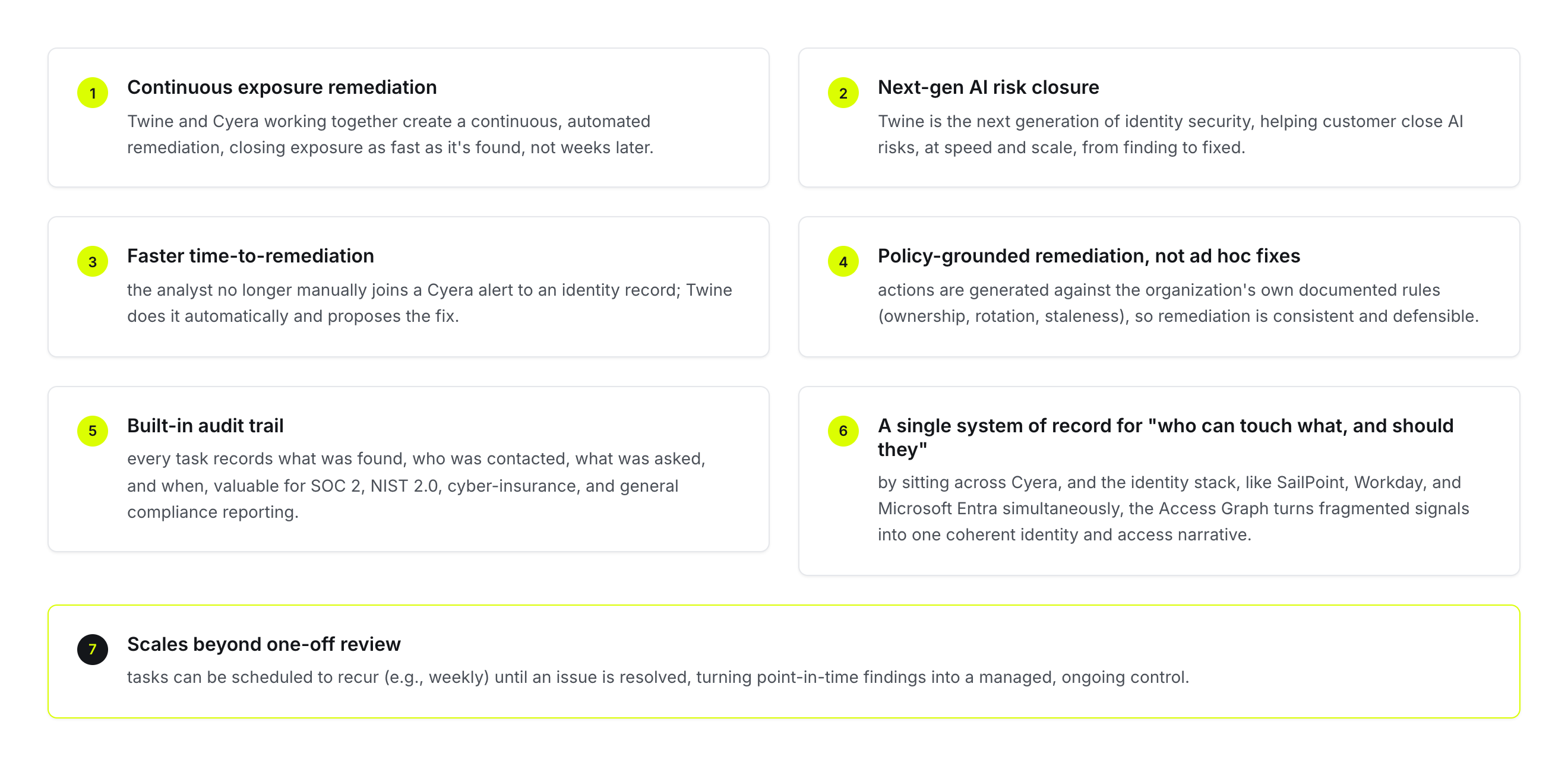
Cyera's intelligence findings, unified with context from both Cyera and Twine, are converted into an owned, trackable, policy-grounded piece of work. When Twine receives relevant risk context from Cyera, it automatically initiates the appropriate identity remediation workflow.
Why This Matters
Conclusion
Cyera and Twine together close a loop that today is mostly bridged by manual effort. Cyera continuously discovers where sensitive data lives across the enterprise and how exposed it is, while Twine adds the identity and organizational context, who an exposed account really belongs to and how it fits the way the organization behaves and governs itself, and carries it through to a resolved, documented, auditable action. The result is a single connected path from data-risk discovery to remediation.
