Copilots vs. Digital Employees in Identity
Copilot speeds up IAM tasks, but enterprise identity requires more.
Assistance Is Not the Same as Accountability.
Author: Yiftach Keshet, Head of Product at Twine
.webp)

TL;DR
Enterprise AI in identity and access management (IAM) is at a fork in the road. One path optimizes the human operator. The other removes the coordination burden altogether.
Most organizations haven’t realized they’re choosing between those two futures.
The Real Distinction
Copilots accelerate tasks. Digital employees own outcomes. That distinction sounds subtle. It isn’t.
A copilot helps a human:
- Draft a remediation plan
- Investigate an alert
- Assemble approvals
- Execute a change faster
But the human still:
- Coordinates stakeholders
- Validates cross-system impact
- Ensures governance is intact
- Owns the final outcome
A digital employee is designed differently. It is accountable for a bounded domain, for example, privileged access governance or legacy access remediation, and is responsible for driving the workflow from:
Plan → Coordinate → Execute → Validate → Document
That difference fundamentally changes the operating model.
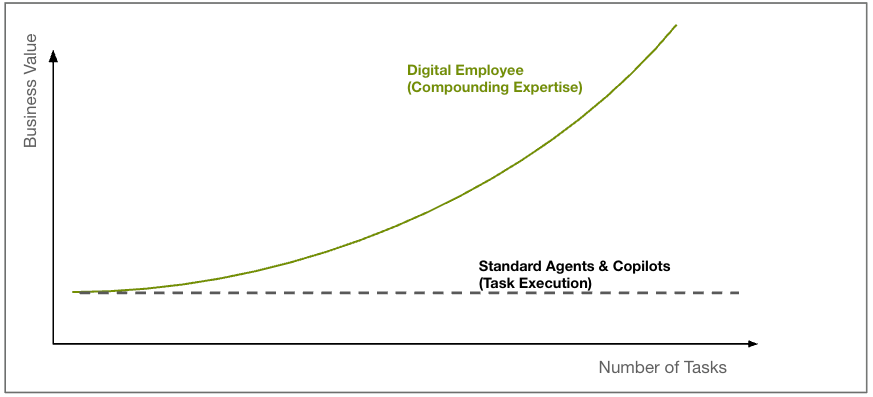
Agents and copilots deliver largely linear value, 1 + 1 = 2. Digital employees, by contrast, generate compounding value over time, as illustrated in the chart below.
The Assumptions Copilots Make (That Break in Enterprise IAM)
Copilots work extremely well in environments where certain conditions hold true:
- Identity data is clean.
- Authority is centralized.
- The operator making the change also understands the business risk.
- The control plane is largely unified under a single vendor.
- Execution authority is consolidated.
In SaaS-native environments, that can be true. In hybrid enterprise IAM, it rarely is. Most mature organizations operate across:
- Entra + Active Directory
- PAM platforms
- IGA systems
- ITSM workflows
- Legacy applications
- Service accounts and scheduled jobs
- Distributed business owners who must approve changes
In reality, the constraint isn’t typing speed or summarization. The constraint is coordination, validation, and governance. Copilots don’t remove that constraint. They optimize inside it.
Data Debt vs. Data Ownership
Here’s a hard truth in identity:
Most IAM programs are limited by data quality.
- Stale ownership records.
- Orphaned accounts.
- Role sprawl.
- Incomplete inventories.
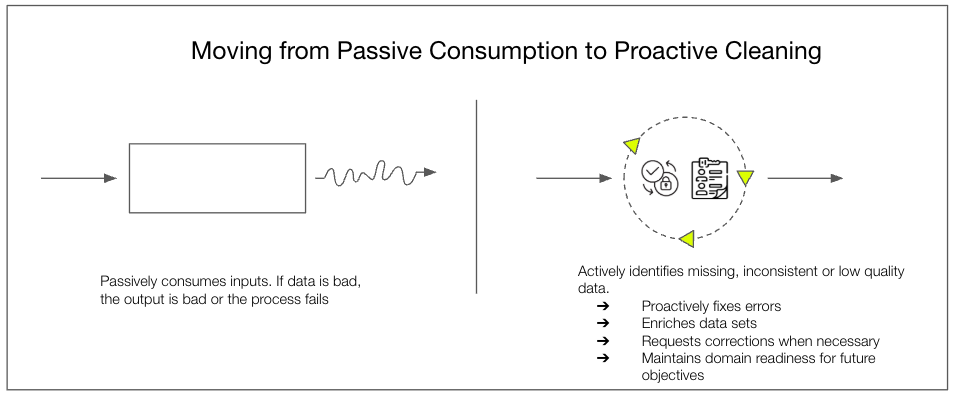
Copilots inherit that data debt. They don’t pay it down. If identity data is inconsistent, incomplete, or fragmented, a copilot can help navigate it, but it won’t repair and maintain it as part of execution.
A digital employee is designed to treat data quality as part of the job.
- Detects missing or inconsistent records
- Enriches ownership and entitlement data
- Requests corrections from accountable parties
- Maintains the domain in a “ready state” for future objectives
That’s a fundamentally different posture. One consumes inputs. The other improves them.
Single Operator vs. Distributed Authority
Enterprise IAM rarely where the person with system access is also the person who owns the risk decision.
Instead:
- IT may execute.
- Security defines policy.
- Application owners approve.
- Risk or compliance validates.
- Audit requests evidence.
Authority is distributed. A copilot assumes a single operator driving a task.
A digital employee assumes fragmented authority and is designed to coordinate across it:
- Identify stakeholders
- Route approvals
- Enforce separation of duties
- Track commitments
- Validate execution
- Generate defensible audit artifacts
That coordination burden is where most IAM programs stall. Not in configuration. In alignment.
Single Vendor Silo vs. Multi-Vendor Reality
Copilots are most powerful when there is a single vendor ecosystem which functions as the primary identity and control fabric.
For example, with Microsoft, when:
- Entra is authoritative
- Defender and Sentinel centralize telemetry
- Intune governs endpoints
Assistance scales cleanly.
But most enterprises are not single-vendor identity environments.
They operate across
- Entra + AD
- Third-party PAM
- IGA platforms
- SaaS sprawl
- On-prem infrastructure
- Custom and legacy systems
No single system defines reality. A digital employee is built on the assumption that governance must span vendors, and unify control logic across them.
That’s not an enhancement. It’s a different design principle.
Tangible Example: Disabling Risky Legacy Access
With a copilot:
- You can identify risky accounts.
- Draft a remediation plan.
- Assemble approvals faster.
- Execute changes within a given platform.
But dependency mapping across:
- Service accounts
- Scheduled jobs
- Application integrations
- Downstream systems
Still requires human validation and coordination.
With a digital employee:
- Dependencies are mapped across systems.
- Owners are identified and engaged.
- Approvals are routed and enforced.
- Changes are executed across platforms.
- Closure is validated with proof.
- Audit evidence is produced automatically.
That is not faster task execution. That is end-to-end domain accountability.
This Is Not About Better Automation
This is about the evolution of enterprise AI:
- Chatbots answer questions.
- Copilots accelerate operators.
- Agents execute bounded actions.
- Digital employees own bounded domains.
The shift from step-optimization to outcome-ownership is the inflection point. In low-complexity environments, assistance is sufficient. In hybrid, regulated enterprises with distributed authority and audit pressure, assistance alone does not reduce risk.
It increases productivity.
It does not change the operating model.
The Strategic Question
If your IAM strategy depends primarily on copilots, you’re optimizing human productivity.
If your strategy is for humans to set the goals and oversee the work, digital employees are the better model.
Copilots improve people. Digital employees change how the work gets done.
The real decision isn’t: “Can AI help our IAM team?”, it’s: “Do we want AI assisting operators, or owning outcomes?”
That distinction will define the next phase of enterprise identity.
